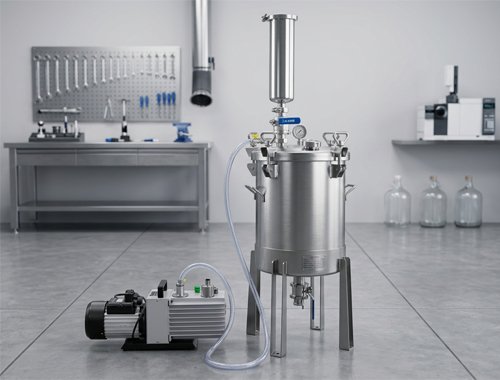
Whether you are formulating premium epoxy resins, developing pharmaceutical gels, mixing cosmetic creams, or preparing silicone molds in a laboratory setting, there is one common, frustrating enemy: trapped air bubbles.
Micro-bubbles inside experimental liquids don’t just ruin the visual aesthetics—they compromise the structural integrity, alter density measurements, and can cause catastrophic failure in cured materials.
In this guide, we’ll explore why traditional bubble-removal methods fall short and how a professional laboratory vacuum degassing machine can elevate your research and small-scale production to flawless standards.
1. Why Do Liquids Trap Bubbles in the Lab?
Bubbles are introduced into laboratory liquids primarily through two mechanisms:
- Mechanical Agitation: High-speed stirring, magnetic mixing, or planetary blending forces ambient air into viscous fluids.
- Chemical Reactions: Many two-part systems (like epoxy resins and hardeners) undergo exothermic reactions that release gas as they cross-link.
When dealing with highly viscous materials (like silicone or polyurethane), these bubbles cannot escape naturally due to the liquid's surface tension and resistance. They remain trapped, waiting to ruin your final result.
2. Why Centrifuges and Sonicators Aren't Always Enough
Many labs try to use existing equipment to solve the bubble problem, but each has its limitations:
- Ultrasonic Baths (Sonicators): Great for low-viscosity aqueous solutions, but highly ineffective for thick resins or gels where bubbles lack the mobility to rise.
- Standard Centrifuges: While high-speed Tubular Centrifuges or laboratory centrifuges are excellent for solid-liquid separation (clarification), using them purely for defoaming viscous fluids can be time-consuming, limits batch sizes, and doesn't remove chemically dissolved gases.
3. The Science of Vacuum Degassing: How It Works
A Laboratory Vacuum Degassing Chamber utilizes fundamental gas laws to achieve 100% bubble-free liquids.
According to Boyle’s Law ($P_1V_1 = P_2V_2$), the volume of a gas is inversely proportional to the pressure exerted on it. When you place your liquid sample inside a heavy-duty vacuum chamber and activate the vacuum pump:
- The Pressure Drops: The atmospheric pressure inside the chamber plummets toward a deep vacuum.
- The Bubbles Expand: As the surrounding pressure drops, the air bubbles inside the liquid expand drastically (often by 50 to 100 times their original size).
- The Rapid Ascent: Due to their massive volume and increased buoyancy, the bubbles violently rise to the surface and burst.
- Dissolved Gas Removal: Beyond visible bubbles, the vacuum pulls out chemically dissolved gases, preventing future outgassing during the curing process.
4. Key Features to Look for in a Laboratory Degassing Machine
When selecting a defoaming system for your lab, a simple "DIY pot" won't cut it for precise scientific work. Look for these professional standards:
- High-Clarity Viewing Windows: A thick, tempered glass or heavy-duty acrylic lid is vital. Liquids expand rapidly under vacuum (sometimes boiling over), and you must be able to monitor the process safely.
- Precision Vacuum Control: A reliable vacuum gauge and adjustable release valves allow you to control the speed of de-aeration, preventing volatile solvents from evaporating or boiling over.
- Chemical-Resistant Seals: Ensure the gaskets (usually silicone or Viton) can withstand exposure to solvent vapors, resins, and cleaning agents.
- Integrated Mixing (Optional but Recommended): For ultra-viscous liquids, a vacuum chamber with an integrated magnetic or mechanical stirrer helps break surface tension and speeds up the degassing process by 3x.
5. Conclusion: Flawless Formulations, Every Time
Don't let trapped air compromise your laboratory data or product quality. Investing in a dedicated, benchtop vacuum degassing system ensures consistency, removes human error, and delivers crystal-clear, structurally sound results for every batch.
Premium Benchtop Vacuum Solutions
At vacuumdegassing.com, we engineer industrial-grade, highly reliable Laboratory Vacuum Degassing Chambers and Systems designed specifically for R&D facilities, universities, and small-batch manufacturers.
From compact desktop chambers for resin casting to advanced vacuum mixing systems compatible with laboratory chilling units or specialized processing equipment, we provide the precise tool your lab requires.
👉 [Browse Our Laboratory Vacuum Systems & Request a Quote Now]