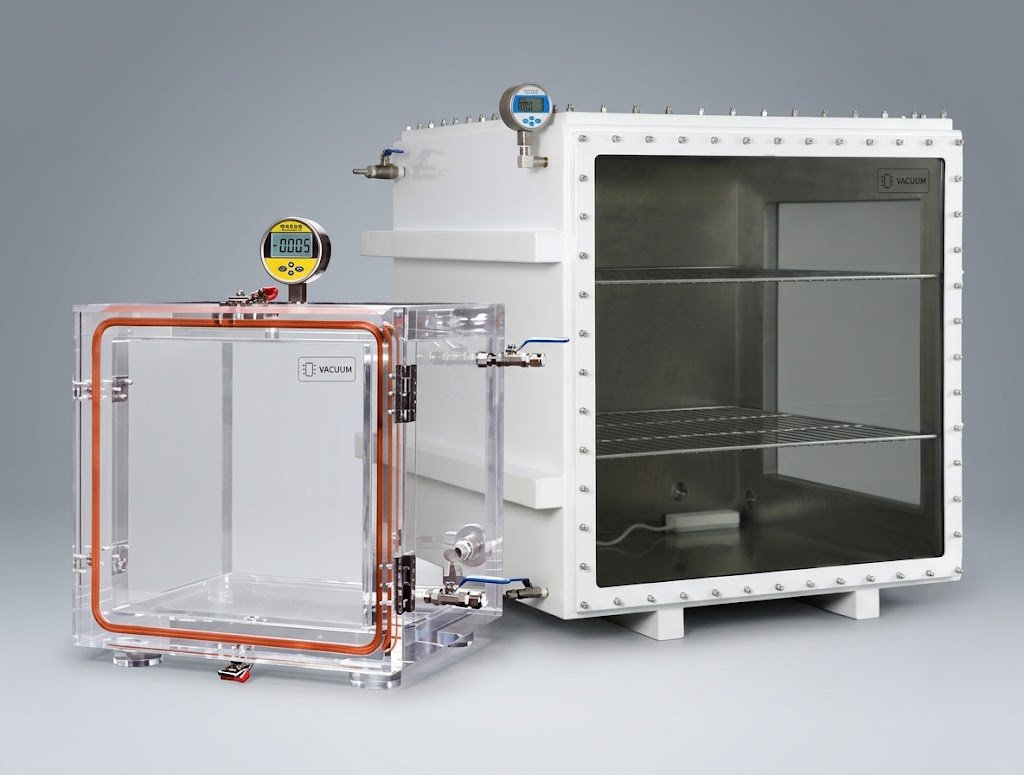
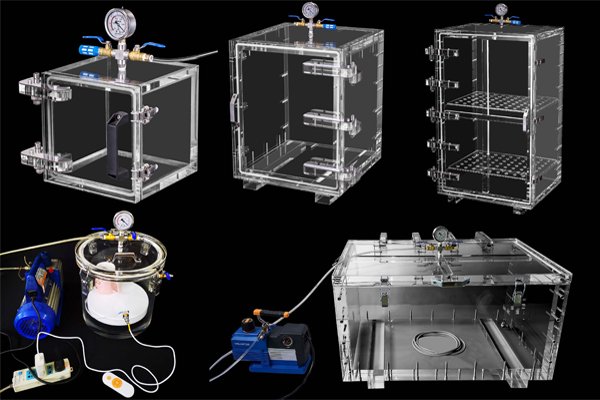
The most popular vacuum chambers on the market are currently acrylic vacuum chambers, also known as PMMA vacuum chambers, polymethyl methacrylate vacuum chambers, and plexiglass vacuum chambers. The biggest advantage of these chambers is their transparency; workers can clearly see what's happening inside the chamber with a 360° view. Furthermore, these acrylic vacuum chambers have relatively good sealing performance, generally meeting the requirements for most electronic components and resin defoaming applications.
The transparent chamber allows staff to clearly see the entire object during experiments. In terms of applications, the most common uses are for sealing tests and calibration tests of electronic components. One of our clients, who manufactures vacuum packaging, places their packages in an empty acrylic chamber filled with water for sealing tests. Another client, who manufactures capsule packaging, performs similar tests. Yet another client manufactures pressure gauges; our acrylic vacuum chambers can be fitted with grids, each grid containing a dozen or so small holes, each hole housing a pressure gauge for easy testing and observation. Another client uses an acrylic vacuum chamber for altitude testing. Because atmospheric pressure decreases with altitude, many skydivers wear watches that measure their current altitude, which include a device that estimates altitude based on air pressure. Applications like these can be tested and verified using an acrylic vacuum chamber.
If your product requires vacuum testing, please contact us for consultation; we will design a solution for you free of charge.
Operational Warning: Chemical Compatibility
Acrylic and polycarbonate vacuum housings are highly vulnerable to volatile organic solvents. Contact with vapors from acetone, thinners, or specific cyanoacrylate compounds induces micro-crazing (structural micro-cracking), which severely undermines the chamber's structural integrity and can lead to implosion under pressure.
To integrate a clear vacuum system effectively, look beyond simple dimensional footprints. Engineering choices must account for structural load placement, custom port routing for electrical signaling or fluid feeds, and the specific vacuum depth your target workflow demands.
From off-the-shelf acrylic configurations to custom-machined chambers with integrated manifolds, our team designs vacuum solutions tailored to precise process parameters.
Speak with an Applications Engineer>>