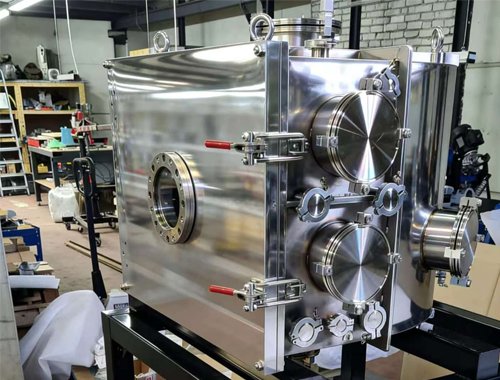
In modern manufacturing and high-tech research, controlling the environment isn’t just a preference—it’s a prerequisite. Whether you are manufacturing microchips or preserving life-saving pharmaceuticals, the presence of ambient air, moisture, and microscopic dust can completely compromise a process.
To eliminate these variables, industries rely heavily on vacuum technology, and the undisputed backbone of this field is the stainless steel vacuum chamber. Typically fabricated from high-grade 304 or 316L stainless steel, these vessels offer the structural integrity, corrosion resistance, and low-outgassing properties required to create pristine, molecule-free environments.
Here is a look at the key commercial and scientific sectors driving the demand for these chambers today.
1. Vacuum Chamber for Semiconductor and Electronics Fabrication
The consumer electronics industry operates on a nanometer scale. Inside today’s smartphones, vehicles, and data centers are microprocessors that require absolutely sterile, ultra-high vacuum (UHV) environments to manufacture.
- Thin-Film Deposition: Techniques such as Chemical Vapor Deposition (CVD) and Physical Vapor Deposition (PVD) use vacuum chambers to deposit atomic layers of conductive or insulating materials onto silicon wafers.
- Etching and Lithography: To carve intricate circuit pathways without interference from airborne particles, the entire process must take place inside highly specialized stainless steel enclosures.
2. Vacuum Chamber for Commercial Aerospace and Space Simulation
Before commercial satellites, weather tracking hardware, or deep-space research instruments leave the ground, they must undergo rigorous testing to ensure survival in the vacuum of space.
- Thermal Vacuum (TVAC) Testing: Large-scale stainless steel chambers replicate the extreme temperature swings and near-zero atmospheric pressure of Earth's orbit. Engineers use these setups to test the structural endurance, thermal management, and electronic reliability of hardware before launch.
3. Vacuum Chamber for Medical and Pharmaceutical Processing
Because stainless steel is non-porous and highly resistant to aggressive cleaning agents, it is the standard material for sanitary and sterile industries.
- Lyophilization (Freeze-Drying): This process is critical for stabilizing vaccines, biological samples, and delicate pharmaceuticals. By lowering the pressure inside a stainless steel chamber, moisture sublimates directly from ice to vapor, preserving the product's shelf-life without damaging its chemical structure.
- Biomedical Degassing: Vacuum chambers are used to pull air bubbles out of liquid compounds, such as medical-grade silicone or polymers, prior to molding. This ensures that implants and medical devices are completely solid and free of structural weak points.
4. Vacuum Chamber for Advanced Material Science and Energy Research
From academic laboratories to green energy startups, pushing the boundaries of physics requires precise environmental control.
- Surface Analysis and Spectroscopy: High-precision instruments like Scanning Electron Microscopes (SEM) require high-vacuum environments so that electron beams can travel smoothly to scan samples at the atomic level.
- Next-Generation Energy: In clean energy research—including advanced solar cell development and experimental fusion energy containment—stainless steel vacuum vessels serve as the primary containment boundaries to isolate high-energy reactions from the external environment.
Why Stainless Steel is the Industry Standard
While alternative materials like aluminum or acrylic are used for low-vacuum, cost-sensitive applications, stainless steel remains irreplaceable for critical systems due to a few distinct engineering advantages:
- Minimal Outgassing: Under a vacuum, materials naturally release trapped gases. Stainless steel has an incredibly low outgassing rate, which is essential for achieving and maintaining high and ultra-high vacuum states.
- Structural Resilience: A vacuum chamber must withstand an inward atmospheric pressure of roughly 10 tons per square meter. Stainless steel offers the mechanical strength to resist deformation over decades of continuous cycling.
- Thermal Tolerance: Many vacuum processes require "bake-outs"—heating the chamber to extreme temperatures to drive off moisture. Stainless steel handles these thermal cycles without warping or compromising its seals.
The stainless steel vacuum chamber is a quiet enabler of modern technological progress. By creating a blank canvas free of atmospheric interference, it allows industries to manufacture the components that power our digital world, develop the medicines that sustain global health, and explore the next frontier of clean energy. As commercial tech demands ever-higher levels of purity and precision, these robust vessels will remain a fundamental piece of industrial infrastructure.
Contact us now to get the best solutions in your working area.